
For two hundred thousand years or so, humanity innovated in two ways:
– Replication: Imitating something seen, as is.
– Serendipity: Surprising findings, eureka moments, strikes of inspiration encountered by an individual. The insight is then replicated by the whole community.
Then, 2,500 years ago, philosophy emerged, most especially with pre-Socratic thinkers like Heraclitus.
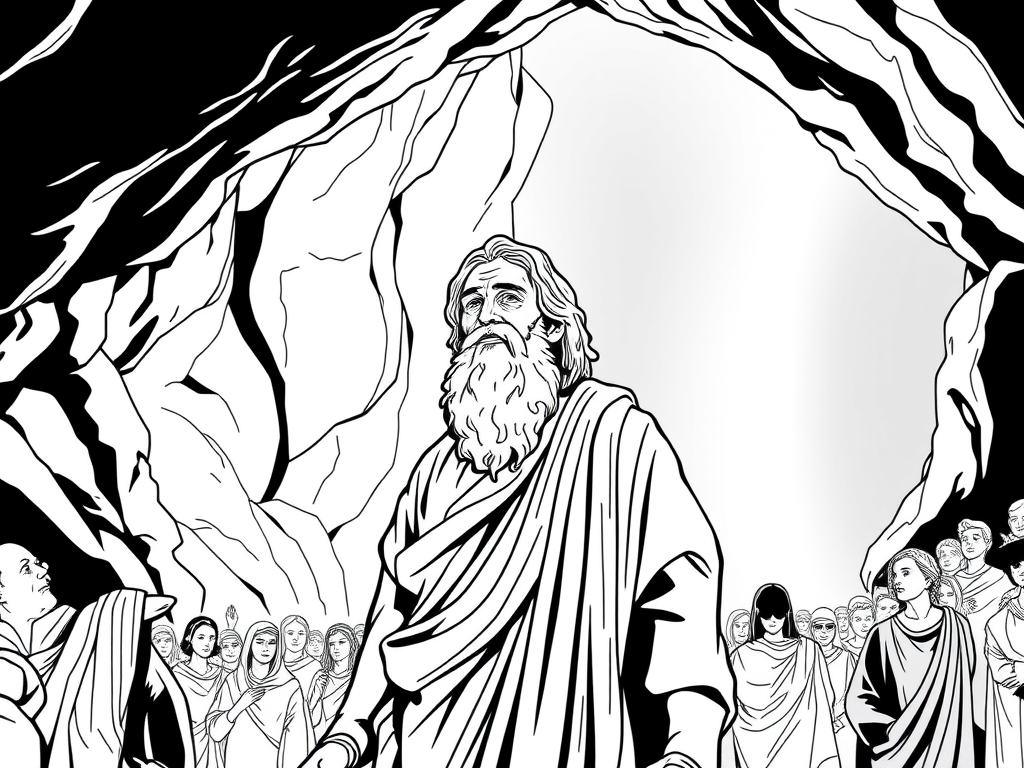
And then Socrates emerged.
Socrates was a conceptual thinker. He saw the world as
patterns
and systems
and forms.
His forms were a form of a shelf. He’d try to find different ways of organizing reality so it would make sense.
Socrates thought Everything Is Beautiful. And in doing so, he saw potential in everything. He saw beauty in everything because he saw how things are. He saw beauty in everything because he saw how people are.
What tripped him up
(what trips me up)
is the things people do.
It’s the choices people make.
Incongruous people.
Untruthful people.
Sophists.
Maybe that’s why he foolishly tried to educate and support Alcibiades. Alcibiades was brilliant and bright. He was a great general, stateman and orator, but he was also ambitious and reckless. Socrates’ choice to try to tutor him and his support of him
his love of him
would help cement his doom.
Just like true Sufis,
just like Socrates,
I’m a fool, too.
I’m a fool in love.
I’m a fool in friendship.
I’m even a fool in my search for a mentor, for guidance, for community.
I believe in people’s capacity for goodness and for greatness. I believe in a Universe that love, change and evolution. I believe the meaning of life is living and I believe that all things begin and end.
Not necessarily in that order.
2,500 years ago, Socrates died and Plato lived.
Socrates was a conceptual thinker. He saw the forms, he saw patterns, he saw how things are.
Plato was a narrative thinker, he saw shadows, he saw connections, he saw how things aren’t.
Socrates died and Plato lived.
The living tell the story.
Plato, out of pain and unbound love, tried to tell a story he only grasped, and gave his Politeia. He knew his forms existed, but he could only see the shadows. So he gave us a tool to make sense of the shadows:
dialectics.
And for 2,500 years, dialectics has amplified narrative minds.
Minds that imitate
Minds that iterate
Minds that oppose
Minds that subvert.
And for 2,500 years, dialectics has marginalized conceptual minds.
Original minds
Holistic minds
Poetic minds
Abstract minds.
How would have Socrates seen physics? Maybe playfully.
How could Socrates have seen Singularities? Maybe he would have considered all sources of knowledge, all types of knowledge.
Fairy tales and religion plus science.
He would have filtered the thought process at the output.
Maybe he would have considered the Book of John.
In the beginning was the Word.
That’s what a narrative mind could say.
In the beginning was the Whole.
Let’s think through this. A black hole eats mass. What if it eats the mass that attracts itself to a tiny, tiny dot? What if the mass accumulates until it reaches a threshold of density, at which point the mass collides with itself, generating a big bang. Singularities are simply planes void of space and time. Planes for which we lack the instruments to measure.
Senseless places.
So the Mass – the Whole – was before the beginning.
Energy – the Word – was at the beginning.
Interesting.
In the beginning was the Word, and the Word was with God, and the Word was God.
He was in the beginning with God.
Okay let me get this straight.
In the beginning, and before the beginning, and after the beginning, there was the System.
There was mass or being – the Whole. There was energy or being – the Word. There weas the observer – God. And He was with the meta-observer, who was God, too, and who was with God, too.
In the beginning there was the System and God was the System and God was the parts of the System and the System was God.
In Him was life, and life was the life of men.
Socrates would have thought of a playful Theory of Everything that observes, and considers, and sees beyond the shadows. Because, like Rumi, he knew the forms and the shadows, he could have known that his senses,
that his mind,
might play tricks, too.
Might have limits, too.
He would have ventured.
Beyond.
Academia is wonderful. Reason is wonderful. I wonder if maybe we can make room for other minds.
Unreasonable minds.
I wonder if we can make room for institutions that find truth through methods other than the scientific method. Educational institutions that foster narrative thinking when suitable, starting at age seven. Educational institutions that bridge gaps instead of widening them.
In this series of books, I’m trying to give you tools to think for yourself. Tools for you to think memetic ideas, emergent ideas, original ideas.
Tools for you to rethink the world.
One more thing.
This book was written in collaboration with ChatGPT, Gemini and Claude.
Is this book mine?
Theirs?
Ours?
I don’t know.
This work is something AI can’t do on its own.
It is something I could have done on my own, but in many months, instead of a few weeks.
My writing itself acts as code for AI because like all good writing and like all good teachers, it’s multidimensional:
it has mind but it also has heart and soul and sensuality.
Is it mine?
Is it theirs?
Is it ours?
It doesn’t matter now.
For it’s ours.
Now, it’s yours.
I am publishing the prologue of my book as a treat to my readers. in was published last November 2024. You can buy the Kindle version here.
Leave a Reply